Thursday, May 31, 2012

The Grand Tetons

Western Tanager on Mary's deck railing.

Statue of elk outside the National Wildlife Art Museum.

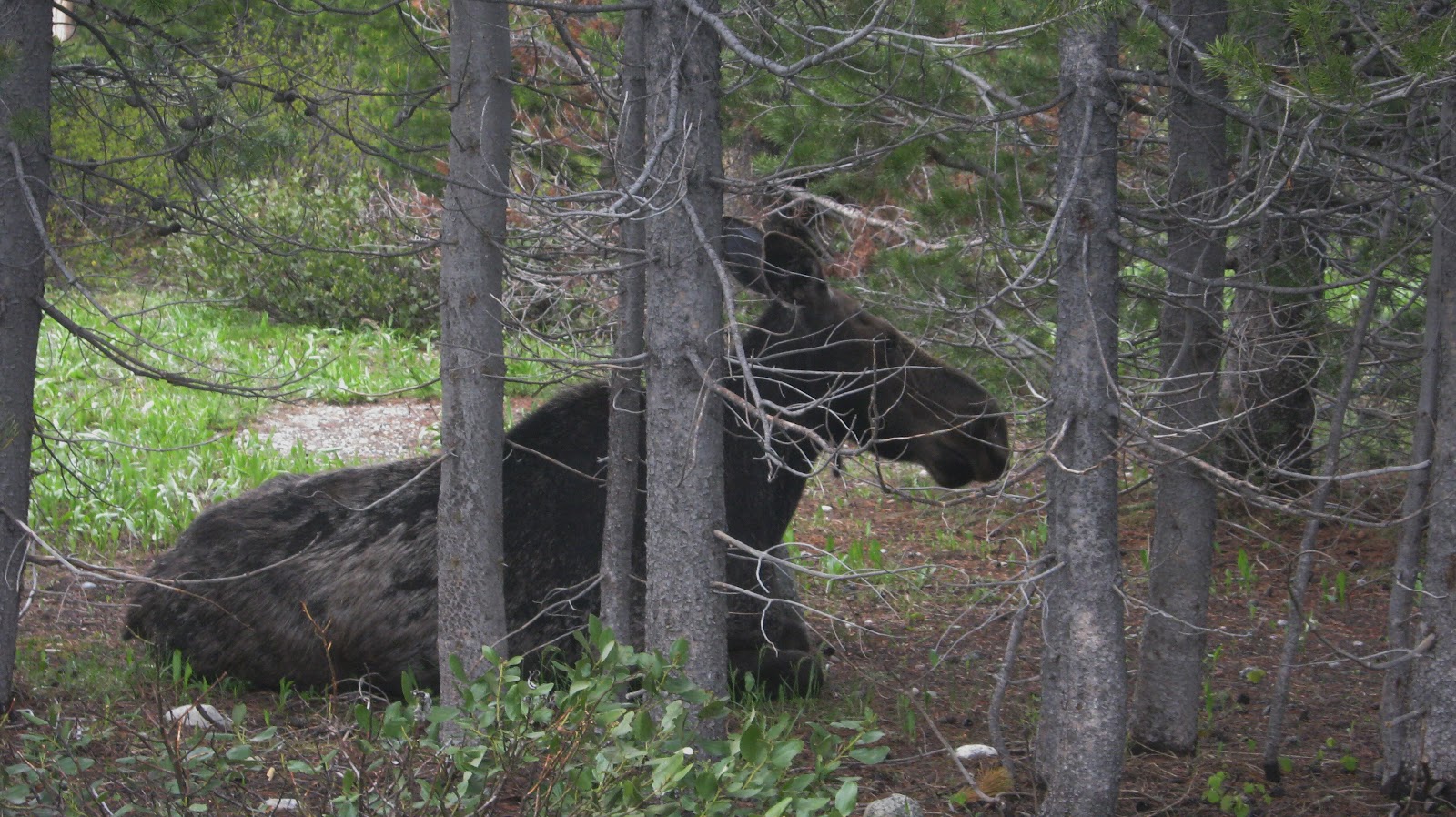
Mother Moose is just relaxing alongside the trail.

Mormon Barn with Tetons. this is the classic view seen on every postcard of the Tetons. Life Motif #1 in Rockport, MA.

Elk on a hillside. They are sleek and have lost their winter coats.

Mary and Catherine by the side of Jenny Lake in Grand Teton National Park.

Relaxing on a hike despite the snow covered rocks.

Bison in a herd next to the road. they are trying to shed their winter scraggy coats.

The Grand Tetons on a cloudy day.

The Grand Tetons don't have any foothills which makes it very dramatic to view them.

Bison Stampede


Buffalo Stampede

There is magic in Jackson Hole! You can’t call it a valley. A “hole” was the term used by pioneer explorers and mountain men to describe any open valley encircled by mountains.

We had snow and rain for a few days which gave me time to recover from the cinders of Craters of the Moon. But we ventured out driving many of the roads in the Park. Going north out of Jackson is the National Elk Refuge, a huge expense of land where they encourage the elk to come down out of the mountains in the winter to feed them. Then the National wildlife Art Museum is a gem with paintings indoors and a new sculpture garden outside. Here we saw a special exhibit by a wildlife artist Bob Kuhn.

On our drives we have encountered herds of bison (buffalo to the uninitiated), moose cows sitting very close to the trail and out along the Snake River, Pronghorn (antelope) grazing in small herds or mom and her one year olds frolicking in the grazing land, Marmots dodging in and out of their holes, a variety of geese and ducks such as the Horned Grebe, and Common Merganser, as well as several bald eagles. On her deck, Mary has nailed several oranges along the railing. The most beautiful Western Tanagers and Magpie have come visiting. We have seen a Mountain bluebird here and I saw a Western Bluebird in Zion. The elk are starting a new set of antlers, as they drop their antlers every year. They are very powerful looking animals and quite majestic.

Even with rain clouds and snow the mountains present a very breathtaking view. They are the newest mountains in the Rockies and are still rising while Jackson Hole is sinking. There is a major fault running along the eastern edge of the mountains. The mountains were uplifted and have very old rock forming the mountains and there are no foothills. The “hole” is sedimentary rock and just tilted slightly. Through all of this the Snake River is carving a wide swath. On the other side of the “hole” are the Gros Ventre Mountains and the Gros Ventre River flows west into the “hole” also. I took a morning float trip down a section of the Snake that is parallel to the Teton Mountains with phenomenal views. Just as I have way too many pictures of Upper Yosemite Falls, I have way too many of the mountains in all of their many presentations.

There are hundreds of miles of trails and we did one which required taking a national Park shuttle launch across Jenny Lake. Then we climbed to the Hidden Falls and Inspiration point. There are also miles of bike paths running through the “hole” just as there were in Yosemite and Zion valleys. There are also some decent rocks for rock climbing and of course two ski areas. Teton Village has a huge tram that runs year round to the summit of Rendezvous Mountain.

Downtown Jackson and Teton village have trendy shops and art galleries. My heart sinks every time I see a Sotheby’s office, because it means I can’t afford to live where they have an office.

On one of our drives we were viewing a herd of Bison and decided to take a side road to get a better view of the herd. Mary is very skittish about getting out of the car when Bison are around because they can run 35 mph and jump high fences from a stand still. As we were cruising slowly down the side road we were using binoculars to watch the bison and some pronghorn, when all of a sudden a Bison jumped out of the bushes and flew across the road in front of us. It was so huge. They can get up a really big head of steam. It was quite dramatic. Then today I had two Pronghorn jump out in front of me and cross the major highway. The Pronghorn are very gazelle-like and very graceful. The bison have been rolling in the dirt to get off their winter coats.

Yesterday I got a canister of pepper spray so that I don’t have to use Mary’s supply. Mary claims she sees bear every time she goes out, but of course not with me along! But there is still Yellowstone!

We leave for Yellowstone on Friday and Mary has a wonderful camping trailer called a “Scamp.” Sleeps two or three and we will use that until she comes home and then I will use my tent. There are over 10,000 geothermal features to see at Yellowstone. I am not quite sure how I will see them all! Pictures to follow.

Sunday, May 27, 2012

Snow squall and tent with lava anchors

The Snake River with the foothills of the Tetons in the distance

Jackson Hole

Large Lava Tunnel

800 ft long lava tunnel

Snow sage brush and rail fence

On the range
colorful Lichen

Climber on the cinder cone

Aa in the foreground, Pahoehoe in middle and cinder cone in the rear

Me being blown off the cinder cone
Lake Tahoe

visibility down to 60 feet

Nevada landscape

How Lava flows

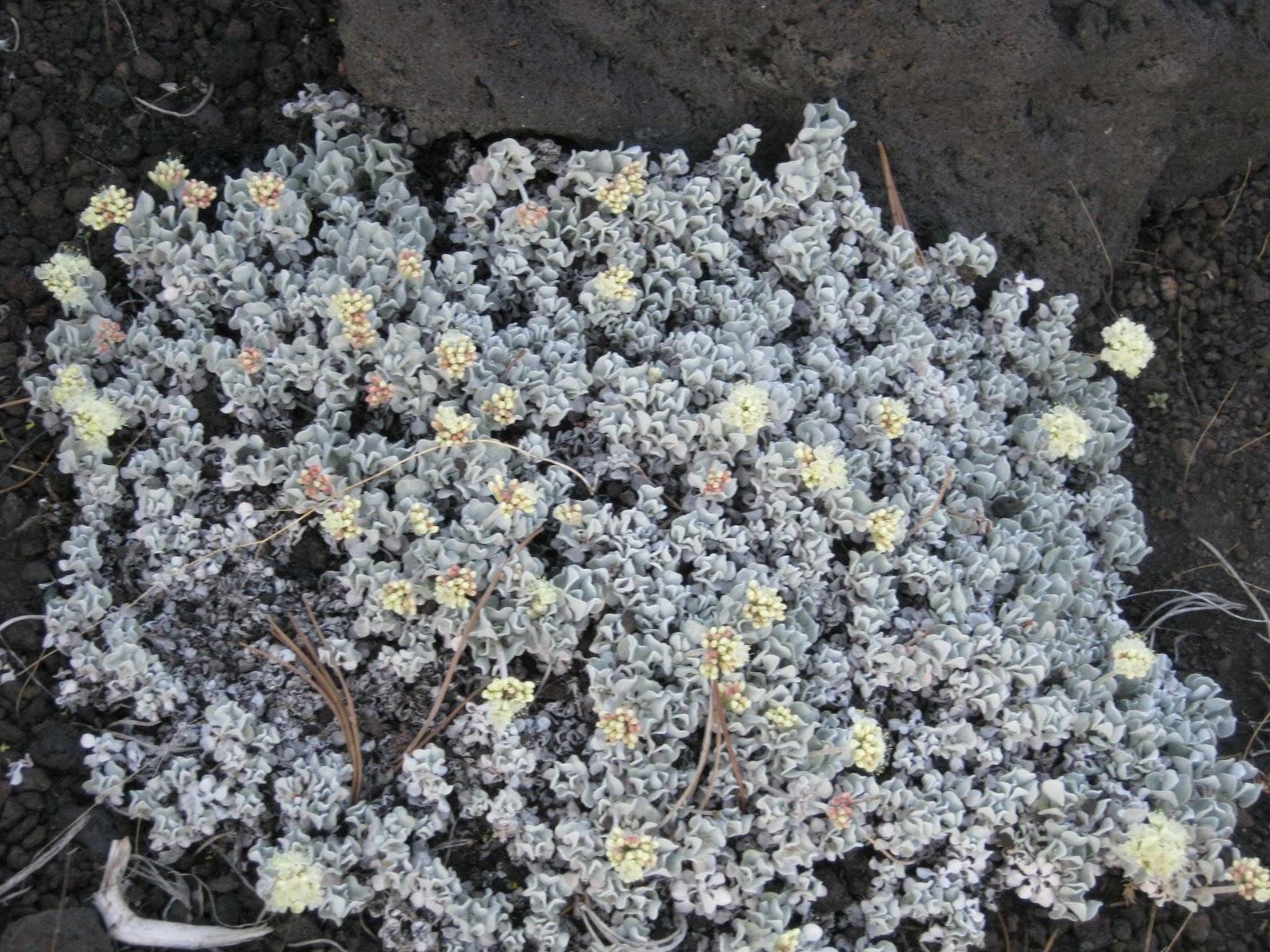
Dwarf Buckwheat

Pahoehoe lava

Splatter cones from cinder cone

Storm Lashing


Crossing Nevada from Tahoe to Idaho took me through the Great Basin or what could be called a Middle Latitude Desert. Pretty sparse. Once in Idaho I was still in the Great Basin but the climate switched to a Middle Latitude Steppe where irrigation allows crops to be grown including the Idaho Potato. Huge irrigation systems spread across the flat landscape. Some irrigation systems go in a circular pattern and some just go straight across a field. I know that from the air, you can see the patterns of the circular irrigation. Giant circles touching in a pattern.

On the drive I kept seeing these long warehouse structures that were low to the ground and covered with sod. Turns out they are to store potatoes and are basically underground. Crops can spend the winter in them without heat or cooling. As another note, the manure smell in Twin Falls was from slaughter houses not spreading manure. Oh joy!

As I got closer to Craters of the Moon National Monument I could see flows of dark rocks jumbled everywhere. Craters of the Moon does not have one giant crater/lava cone but a series of little spatter cones. The Snake River Plain (also called the Great Rift Volcanic Rift Zone) arcs across southern Idaho from Twin Falls to Idaho Falls and on to Yellowstone. The plain marks the passage of the Earth’s crust over an unusual geologic heat source that now brings the inner workings of the earth so close to the surface at Yellowstone. This same hotspot that is under Yellowstone now is the same one that created Craters of the Moon.  Craters of the Moon has experienced a series of lava eruptions through parallel fissures in the earth’s crust in the Great Rift Valley. The first eruptions were 15000 years ago down towards Twin Falls and have erupted every 2000 years  since, slowly moving north east over the hotspot. So there is a series of spatter cones running all along the line from Twin Falls to Yellowstone. It is time for another eruption give or take a 1000 years.

When you first see Craters of the Moon all you see is black but then as you look closer you start seeing vegetation starting to creep its’ way into cracks and crevices and colorful lichen clinging to the rocks. It seems pretty ugly at first but then it grows on you. The place was named in 1920 and it looked like what they could see of the moon but the moon’s craters are made from meteorites and are not volcanic.

When I was driving to “the Moon” the wind was strong and it was only 49 degrees and then it got colder and the wind picked up and was going a full 50 mph with gusts up to 55 mph when I was trying to erect my tent. The place is full of three kinds of lava, one of which is “cinders” and the cinders were flying and black grit was flying. After about two hours and finally putting lava rocks over my tent stakes I finally got my tent up and storm lashed.  The wind was so strong it was pulling out the tent stakes. I even had lava rocks inside to keep the floor of the tent from trying to fly away. Storm lashing is a set of extra ropes crossed over the tent and tarp to help hold them down. Luckily I had recently bought some extra stakes so that I had enough to do the job. Freaked me out actually!

I stayed at “The Moon” for 4 nights.  I did a bunch of day hikes to points of interest and hiked up a giant cinder cone and almost got blown off. One day I took a ranger led hike to some lava tunnels. The lava hardens on the outside and the hot lava continues to run through and leaves tunnels. One day I hid in bed until 11 and then drove to Arco and had a huge meal and hid out in my car. The wind just did not stop and sometimes brought rain splatters and snow squalls despite the temps at 39 degrees. It was very wearing to be out in such wind with the insidious grit everywhere.

Finally escaped from there on Friday morning and headed for Jackson and the Grand Tetons. I went up the foothills and over two passes and came out on Jackson Hole where my friend and sorority sister, Mary lives. I had always pictured Jackson Hole to be a narrow Swiss-like alpine valley and had a shock when I discovered it was a very wide plain almost. Teton is the touristy funky center and Jackson is for the real folk. Mary has graciously offered me a bed here for the week and I am lovin’ it already! She also has a Scamp trailer that we will take up to Yellowstone.

Since I have been in Jackson it has been spritzing rain and snowing so we have revved up the wood stove and enjoyed lazing around. There are some wonderful birds such as the Western Tanager in her vicinity as well as a variety of hummingbirds and a pair of huge Magpies with a nest in a nearby tree. The tanagers are bright yellow with crimson heads and I saw four all at once yesterday.

The weather is supposed to be nice tomorrow and the rest of the week so we will venture into the Grand Tetons National Park area then.

Monday, May 21, 2012

Done with Nevada

Today I got up early and left S Lake Tahoe at 7 am and crossed into Idaho late in the afternoon and encountered a time change. I went as far as Twin Falls, Idaho. I don't know what the mileage was. I don't think I ever will feel the need to go back to Nevada. It was brown from start to finish. I spent most of the day driving up route I-80 in this huge valley with mountains on one side and rounded lower hills on the other. Then up route 93 into Idaho.
At the start my GPS, Loraine, took me an interesting route that was ok but enough is enough. I finally had to put a book on CD in and just drive.
There was one interesting section that had a volcanic cone and alkali flats and maybe a potash plant and an area with hot springs that were steaming all over. Then it was just one big blur of brown. I think they just covered the irrigated fields here in Twin Falls with manure, as the  smell is pervading the air.
Tomorrow I am headed for Craters of the Moon National Monument and then I will be staying at my sorority sister's house from college while I am in the Tetons. Then she and I are going with her camper to Yellowstone.